Italy is home to a wide array of historic football stadiums that host everything from local derbies to major international tournaments. This page provides a guide to some of the country’s most prominent venues, categorized by city.
Bergamo
Stadio Atleti Azzurri d’Italia
The home of Atalanta BC, this stadium has undergone a radical transformation in recent years, becoming one of the few club-owned facilities in Italy. Situated at the foot of the Città Alta, its recent redevelopment removed the original curves to create modern stands close to the pitch, drastically improving the fan experience and making it a model of efficiency for mid-sized clubs in Europe.
Florence
Stadio Artemio Franchi
The home of ACF Fiorentina, this stadium is a masterpiece of Italian Rationalism. Designed by Pier Luigi Nervi, it is famous for its “Maratona” tower and its unique “D” shaped structure. It was a key venue for the 1934 and 1990 FIFA World Cups and remains one of the most distinctive architectural landmarks in Italian sport.
Genoa
Stadio Luigi Ferraris
Commonly known as “Marassi” after the district where it is located, this is Italy’s oldest stadium still in use. It serves as the home ground for both Genoa CFC and UC Sampdoria. Its English-style architecture, with stands close to the pitch, creates one of the most intense and intimidating atmospheres in Italian football.
Milan
Stadio Giuseppe Meazza (San Siro)
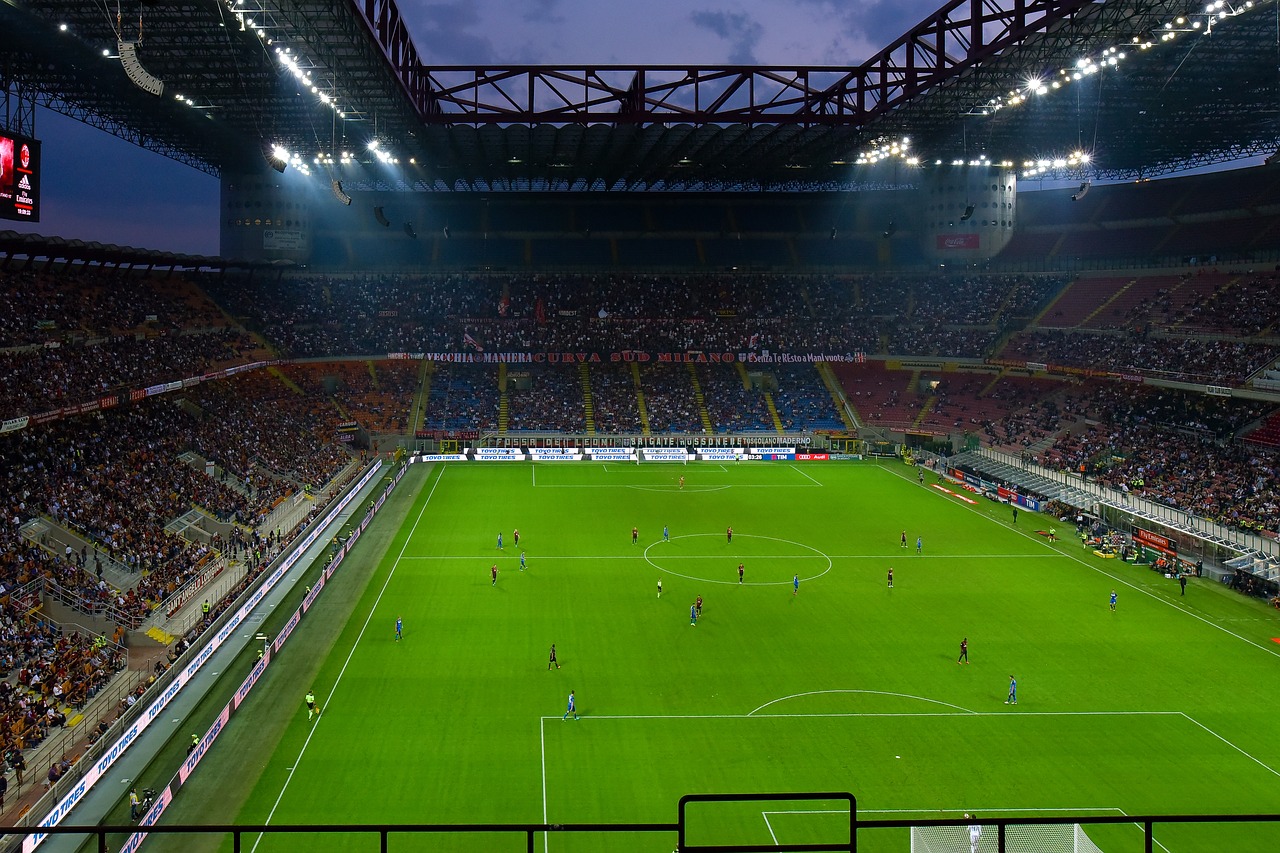
Known globally as the “San Siro,” this iconic stadium is the home of both AC Milan and Inter Milan. It is characterized by its massive cylindrical towers and red girders. Often described as “La Scala del Calcio,” it has hosted multiple European Cup finals and was a centerpiece for the 1990 World Cup. It is scheduled to host the opening ceremony of the 2026 Winter Olympics.
Naples
Stadio Diego Armando Maradona
Formerly known as the Stadio San Paolo, this venue was renamed in 2020 to honor the legendary Argentine who led SSC Napoli to two Serie A titles. It is the third-largest stadium in Italy and is famous for its raucous atmosphere. The stadium underwent significant renovations for the 2019 Summer Universiade, modernizing its seating and track.
Parma
Stadio Ennio Tardini
Inaugurato in 1923, the Tardini is the historic home of Parma Calcio 1913. It is one of the oldest stadiums in Italy and stands out for its location in the heart of the city. With its monumental facade and compact design, it offers a welcoming and traditional atmosphere, bearing witness to the club’s golden era in the 1990s.
Rome
Stadio Olimpico
Located within the Foro Italico sports complex, the Olimpico is the home of both AS Roma and SS Lazio. As Italy’s national stadium, it hosted the 1960 Summer Olympics, the 1990 World Cup final, and the 2009 UEFA Champions League final. It is a multi-purpose venue that also serves as the headquarters for the Italian National Olympic Committee (CONI).
Turin
Juventus Stadium
Opened in 2011, this was the first club-owned stadium in Italy, representing a major shift in Italian football infrastructure. It is built on the site of the former Stadio delle Alpi and is celebrated for its modern facilities, sustainability, and intimacy. It provides a world-class matchday experience that has become a model for other Italian clubs.
Stadio Olimpico Grande Torino
Originally built for the 1934 World Cup and later renovated for the 2006 Winter Olympics, this stadium is the home of Torino FC. It is named in honor of the “Grande Torino” team of the 1940s. The venue is known for its distinctive 1930s facade and its role as a central hub for the city’s sporting history.
Verona
Stadio Marcantonio Bentegodi
This venue is the home of Hellas Verona and formerly Chievo Verona. It was famously renovated for the 1990 World Cup, which included the addition of a roof over all sections. It is a classic Italian multi-use bowl that has seen some of the most historic moments in provincial Italian football, including Hellas Verona’s unlikely Scudetto win in 1985.
Last Updated on February 10, 2026 by Sports Tourist